Evidence
From gold-standard validation to real-world use
MoveLab combines peer-reviewed technical validation with a growing body of evidence from clinical, research and real-world use.
Its movement measurement technology has been evaluated against gold-standard motion capture and established clinical reference assessments, while MoveLab has also been used by patients and clinicians across home, research and NHS clinical environments.
Selected examples include use by people living with haemophilia, multiple sclerosis, stroke and spinal cord injury, alongside longitudinal independent use and controlled validation studies.
Together, these studies and implementations build a cumulative evidence base spanning measurement performance, usability, remote assessment, longitudinal monitoring and intervention evaluation.
Evidence at a glance
What the numbers show
2
Peer-reviewed validation studies
24–76 years
Age range in one fully remote clinical feasibility study
15
Participants completing remote functional assessment in the TEMPO study
20
Participants in an NHS gait-analysis service evaluation
4+
Clinical populations represented in the selected real-world examples below
120+
Movement assessments recorded during one longitudinal stroke-survivor example
Demonstrated
What has already been demonstrated?
Validated movement measurement
MoveLab’s camera- and sensor-based measurement approaches have been compared with established reference methods in peer-reviewed research.
- Smartphone gait analysis compared with gold-standard 3D motion capture
- TUG and 30-second Sit-to-Stand compared with clinical-standard assessment
- Camera-based joint-angle and range-of-motion measurement compared with 3D motion capture
Remote assessment is feasible
MoveLab has already been used to deliver functional assessment outside the clinic. In the TEMPO study, adults with haemophilia aged 24–76 completed a fully remote MoveLab assessment using everyday technology.
- 15 of 16 enrolled participants completed all study elements
- No adverse events reported
- Functional assessment completed in participants’ own environments
- Positive feedback on convenience, usability and reduced travel
Used with real clinical populations
MoveLab has been used beyond laboratory validation in clinical research, NHS service evaluation and real-world monitoring. Selected examples on this page include people living with:
- Haemophilia
- Multiple sclerosis
- Stroke
- Spinal cord injury
Longitudinal measurement
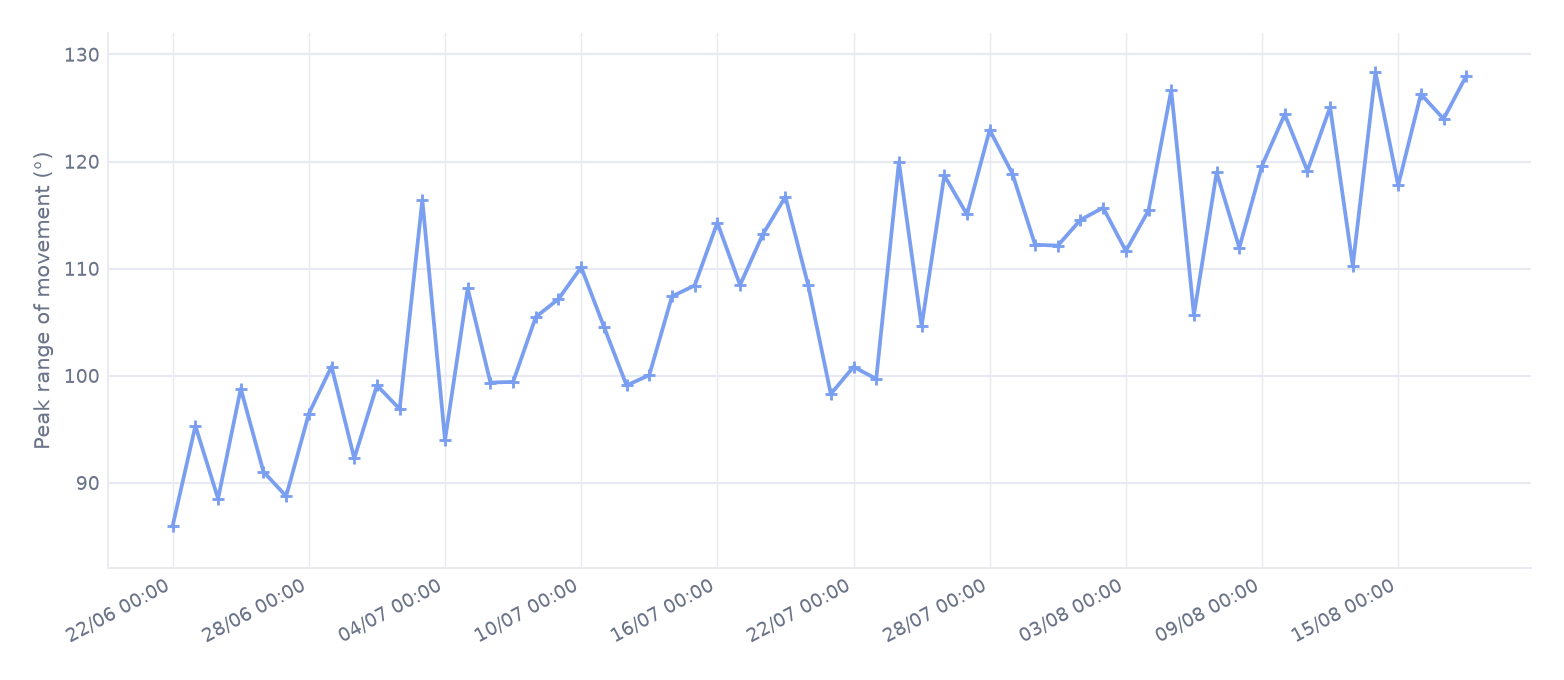
MoveLab enables repeated objective measurement rather than relying on isolated snapshots. In one independent example, a stroke survivor recorded more than 40 assessments in 20 days and subsequently more than 120 movement logs while also tracking pain and difficulty.
- Movement graphs and joint angles reviewed over time
- Pain and difficulty logged alongside movement
- Visual history used to examine change
Peer-reviewed validation
Smartphone gait, TUG and Sit-to-Stand
In a peer-reviewed 2025 study involving 25 healthy adults, MoveLab was compared with gold-standard 3D marker-based motion capture and clinical-standard functional assessments.
Gait speed
ICC 0.761
Step time
ICC 0.866
Cycle time
ICC 0.894
Stance time
ICC 0.864
Cadence
ICC 0.859
Timed-Up-and-Go
ICC 0.757
30-second Sit-to-Stand
ICC 0.959
The study provides peer-reviewed validation evidence across a range of clinically relevant gait and functional mobility measurements.
Peer-reviewed validation
Joint angles and range of motion
A peer-reviewed study involving 22 healthy volunteers compared MoveLab's underlying markerless pose-estimation approach with laboratory 3D Qualisys motion capture during upper- and lower-limb movements.
Joint angles were derived from multiple anatomical landmarks — wrist, elbow and shoulder for elbow movement, and ankle, knee and hip for knee movement — testing the ability of ordinary video to track the body accurately enough to reproduce objective joint measurements.
<10%
Variation across all joint-angle time-series comparisons
ICC up to 0.95
Knee range of motion
ICC up to 0.94
Elbow range of motion
Gold-standard comparison
Ordinary video vs 3D motion capture
All joint-angle time-series comparisons across the five tested activities were below 10% variation compared with the laboratory reference measurements.
The study cites a 20 mm coordinate-position error margin for the 3D laboratory reference standard and concluded that the vision models produced 2D outputs within a 10% variation of that reference-standard error margin.
The findings provide peer-reviewed evidence that markerless video can accurately track the anatomical landmarks required to generate objective joint-angle and range-of-motion measurements using ordinary video capture.
Real-world evidence
Selected real-world evidence
MoveLab has been used in a range of clinical, research and real-world settings. The examples below illustrate different aspects of that growing evidence base — from fully remote assessment and NHS clinical use to repeated longitudinal measurement.
Taking functional assessment into the home
Remote Timed-Up-and-Go assessment in adults with haemophilia
15 of 16
enrolled participants completed all study elements
0
adverse events reported
40%
recorded TUG times above the 12-second threshold used in the study
r = 0.623
positive relationship between TUG time and age
Participants performed TUG remotely following on-screen MoveLab instructions and provided feedback on the experience. Feedback highlighted ease of use, clear instructions, convenience, reduced travel and flexibility around work and daily life.
A real-world example of patients completing objective functional assessment remotely using everyday technology.
Objective gait measurement in an NHS FES clinic
Measuring gait with an intervention switched ON and OFF
20
participants
13
Multiple sclerosis
6
Stroke
1
Spinal cord injury
The Rehabilitation Engineering Unit at Swansea Bay University Health Board evaluated MoveLab with people using Odstock Dropped-Foot Stimulators.
Participants completed gait assessments with FES switched ON and OFF, with MoveLab automatically generating objective measures including speed, cadence, stride and step parameters.
- MoveLab required minimal familiarisation
- Objective gait data was generated successfully within the clinical setting
- The system provided richer gait information than visual observation alone
- Of the 11 participants who walked faster with FES, 8 exceeded the ≥0.05 m/s clinically meaningful change threshold used in the evaluation
- On-screen gait information supported discussion of individual responses to FES
An example of MoveLab being used with real neurological patients to objectively quantify movement around an intervention.
More than 120 assessments tracking movement over time
One example of longitudinal independent MoveLab use
In one independent real-world example, a stroke survivor used MoveLab repeatedly to track upper-limb movement alongside pain and difficulty.
40+
logs in the first 20 days
120+
movement logs during continued use
The participant used:
- movement curves
- joint-angle data
- affected/unaffected-side comparisons
- pain and difficulty logging
- visual history over time
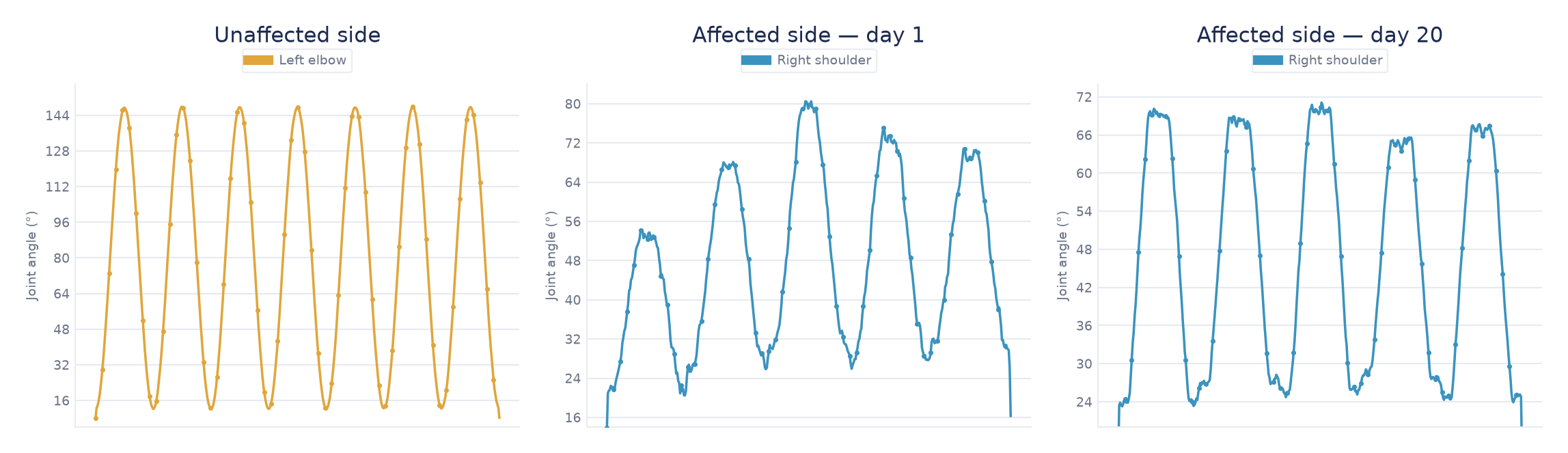
“A very clever program. Not only does it quantify movements it also provides a visual history. It acts as a motivational tool for specific movements.”
“I can also see where I have weakness or tightness.”
Transferable evidence
Evidence that travels across use cases
Different pathways may use MoveLab for different reasons, but many of the practical questions about objective movement measurement are shared. Across MoveLab’s validation, clinical, research and real-world experience, evidence has accumulated around recurring questions.
Can people complete MoveLab assessments?
MoveLab has been used successfully by healthy volunteers and by people living with a range of health conditions.
Can assessments be completed remotely?
Yes. Selected projects have involved participants completing functional assessments from their own homes using ordinary technology.
Can MoveLab be used in real clinical environments?
Yes. MoveLab has been evaluated and used within NHS clinical services as well as in research settings.
Can it generate objective data around an intervention?
Yes. In the Swansea Bay FES evaluation, MoveLab measured gait with treatment switched ON and OFF, demonstrating how the platform can quantify movement around an intervention.
Can it support repeated measurement?
Yes. MoveLab has been used for repeated longitudinal tracking, including more than 120 assessments by an individual stroke survivor.
These examples contribute to a cumulative MoveLab evidence base.
Areas we are actively extending
Building the next evidence
MoveLab’s evidence base continues to grow through healthcare, academic and industry collaborations.
We are particularly interested in projects that use objective movement measurement to evaluate:
Where appropriate, projects can also compare MoveLab measurements with established clinical or research outcome measures.
Evaluating an intervention?
If you are developing an intervention and need to demonstrate its effect on physical function, MoveLab provides a ready-made environment for objective and repeatable measurement.
Available measures can include:
We are particularly interested in collaborations designed to produce robust external evidence, conference presentations or peer-reviewed research.
Discuss a research projectGo deeper
The publications and the methods behind them
Full study summaries — population, reference standard and results — plus plain explanations of how each measurement approach works.
Get started
See how MoveLab could support your pathway
Book a clinical demo to explore how camera-based assessment, phone sensor analysis and wearable activity data could fit into your service, research project or partnership model.
Net Zero delivery on patient-owned devices — at around 1% the cost of a traditional in-person appointment.